

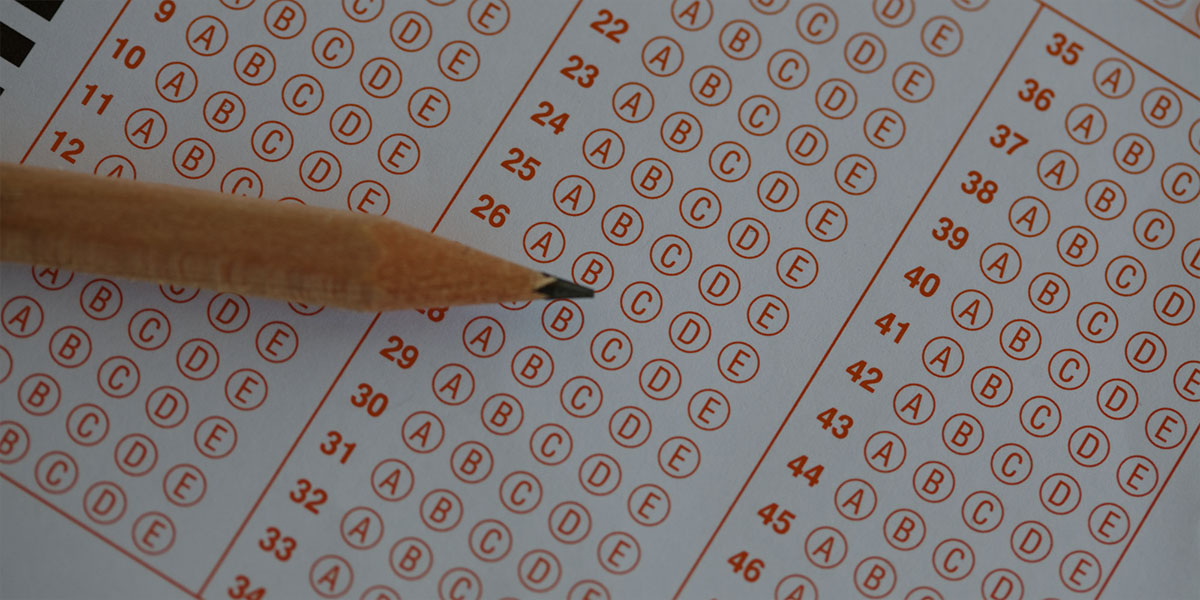
Pacing is a common problem that plagues many students on the ACT. In discussing a couple of overall pacing strategies, we'll use the Science section as a reference, but you’ll see that these techniques are applicable to almost any section of the ACT.
The most important thing is to accept that [students] will have to randomly guess on some questions and to find a way to strategically determine what those questions will be.
Each year, we see some students who answer questions very accurately but simply can’t finish ACT sections on time. While our final goal is always to help students finish all of the questions in the time allotted, and usually we are successful in that goal, at times students get to their official test date and are still unable to finish all of the questions. That’s okay! For these students, it is incredibly important to have solid test management.
The first important step in effective test management is to accept that randomly guessing on some questions will be necessary, and to find a way to strategically determine what those questions will be. In general, you want the questions that you end up randomly guessing on to be the questions that you would be likely to struggle with even if you had unlimited time.
Most students complete the questions in the order that they are given. This is perfectly natural, of course. No one sits down to a history exam and says, “Ok, I think I’ll start at the last question today.” On the ACT, however, doing the questions in the order that they are given can hurt your score.
Let’s say that you estimate that you’ll be able to complete 30 out of the 40 questions on the Science section. If you simply do questions 1–30, there’s no guarantee that those questions were the easiest or best 30 questions for you to complete. Maybe questions 35–40 were incredibly easy, and questions 1–7 were very difficult. On the ACT Science section, you should have a good idea of what types of passages you like and don’t like. Sure, you don’t need to be an expert in a given scientific field to get the questions correct, but it always helps to be familiar and comfortable with the subject matter. So, if you hate physics, and the first passage describes an experiment to test the energies of different electron levels in a helium atom, skip that entire passage.
The questions that you skip here will be more than compensated for by the easier questions you answer later. You’re not “giving up” on the first passage: You’re making sure that you answer the easiest questions in the Science section. Answering easier questions means higher accuracy, and higher accuracy means higher scores! Of course, you'll want to be sure to select random answers for any questions that you skip; you may find that you earn extra points this way!
It is totally okay to skip individual questions due to pacing concerns, even if you think you would be likely to get the question correct if you tried it.
This technique applies to individual questions, as well. If you’ve taken a practice test, you’ve seen that the questions and answers on the ACT Science section vary greatly in their length. You can probably see where I’m going with this. For students who know they will be pressed for time, it can be a good idea to skip the longest questions. The reason for this is not solely the length of the question. Longer questions with full sentences as answer choices tend to actually require you to understand the passage, whereas shorter questions with numbers as answer choices tend to be “go find me some information from a table or graph” questions. In fact, many of the shorter questions actually tell you exactly where the answer is. Science questions that start with words such as “In figure 2…” or “According to table 1…” tend to be fairly straightforward. The bottom line is this: it is okay to skip individual questions due to pacing concerns, even if you think you would be likely to get the question correct if you tried it.
Remember that you get to make your own decisions about what questions you answer and which order you answer them in. If you think about the overall test along with your strengths and weaknesses, you’ll be able to make these decisions in a way that gets you the most points possible.
Related Posts
How To: Avoid Running Out of Time on the Reading Section
How To: Keep Your Cool on the ACT Science Section


